

HERITAGE

NATURE

PICTURESQUE
Why we LOVE Eleousa
Old Italian-era buildings, once full of life, still stand around the peaceful square, showing beautiful architectural details despite the passing years. Tall pine trees create a calm atmosphere, while the large church gives the village its quiet character. Just a short walk away, visitors can also find one of Eleousa’s hidden gems — a large fountain and a cistern with cold spring water flowing directly from the mountain.
Many travelers wonder why such a beautiful place feels so empty today. Eleousa was originally built during the Italian period on Rhodes and was planned as a mountain settlement. Although parts of the village were later abandoned, its charm never disappeared. Today, Eleousa remains a unique place to visit — combining nature, history, and a touch of nostalgia that makes it different from anywhere else on the island.

The Square in Eleousa village
For us, Eleousa has always been a favorite little stop between a Sunday church visit and a family lunch at a traditional village tavern. Every season gives the area a different charm. In spring, the hills become green and colorful with wild herbs and blooming bushes, attracting locals for long walks, hikes, and bike rides through nature. In autumn, the large plane trees covering the village turn golden and red, creating the perfect place to enjoy the crunchy autumn leaves and cool mountain air.
Eleousa is also the starting point of one of the most scenic mountain routes on Rhodes, leading through peaceful pine forests to the charming St. Nectarios Church, the historic Elafos & Elafina mountain villas, and the mysterious Villa de Vecchi
From Campochiaro to the Italian “Ghost town”
Eleousa is actually a relatively modern settlement. The village was established in 1935 during the Italian occupation of Rhodes and originally carried the name Campochiaro. It was created as a small mountain community for lumberjacks and sawyers who arrived from the Fiemme Valley in northern Italy to work in the surrounding forests.
Campochiaro became one of four rural villages built by the Italian administration as part of a wider plan to organize agricultural production on the island and strengthen the presence of the political regime at the time. Even today, the village still reflects this unique period of Rhodes’ history through its Italian-style architecture and carefully planned layout.

Lumberjacks and sawyers from the Fiemme Valley in northern Italy
From the very beginning of the Italian occupation, the rulers of Rhodes recognized the great potential of the island’s fertile land and mountain forests. Governor Mario Lago aimed to transform Rhodes into a successful showcase of the Italian colonial empire. During this period, large public works projects reshaped the island — new roads connected remote villages to the capital, impressive public buildings appeared in the era’s popular architectural style, and important water supply systems were constructed across the countryside.
By the time Eleousa — then known as Campochiaro — was established, Rhodes was already being promoted as an exotic and elegant Mediterranean destination attracting officials and wealthy travelers from Italy, Greece, Egypt, and the Middle East.
A short documentary offers a fascinating glimpse into how Rhodes was presented during the Italian period before World War II. Check HERE.
To manage the vast forests of central Rhodes, the Italian administration needed experienced workers. In 1934, Governor Mario Lago invited around 30 families from northern Italy to settle on the island and oversee nearly 55,000 hectares of mature forest. The offer was attractive: stable salaries, benefits, a newly built village with a church and school, and a house with land for every family.
For many skilled workers from the Trentino region, where unemployment and poverty were widespread at the time, this was a rare opportunity for a better future. The new settlement — today’s Eleousa — was built about 300 meters above sea level in the cool mountain landscape, giving the newcomers a familiar alpine atmosphere, while still being only about an hour from the capital of the island.
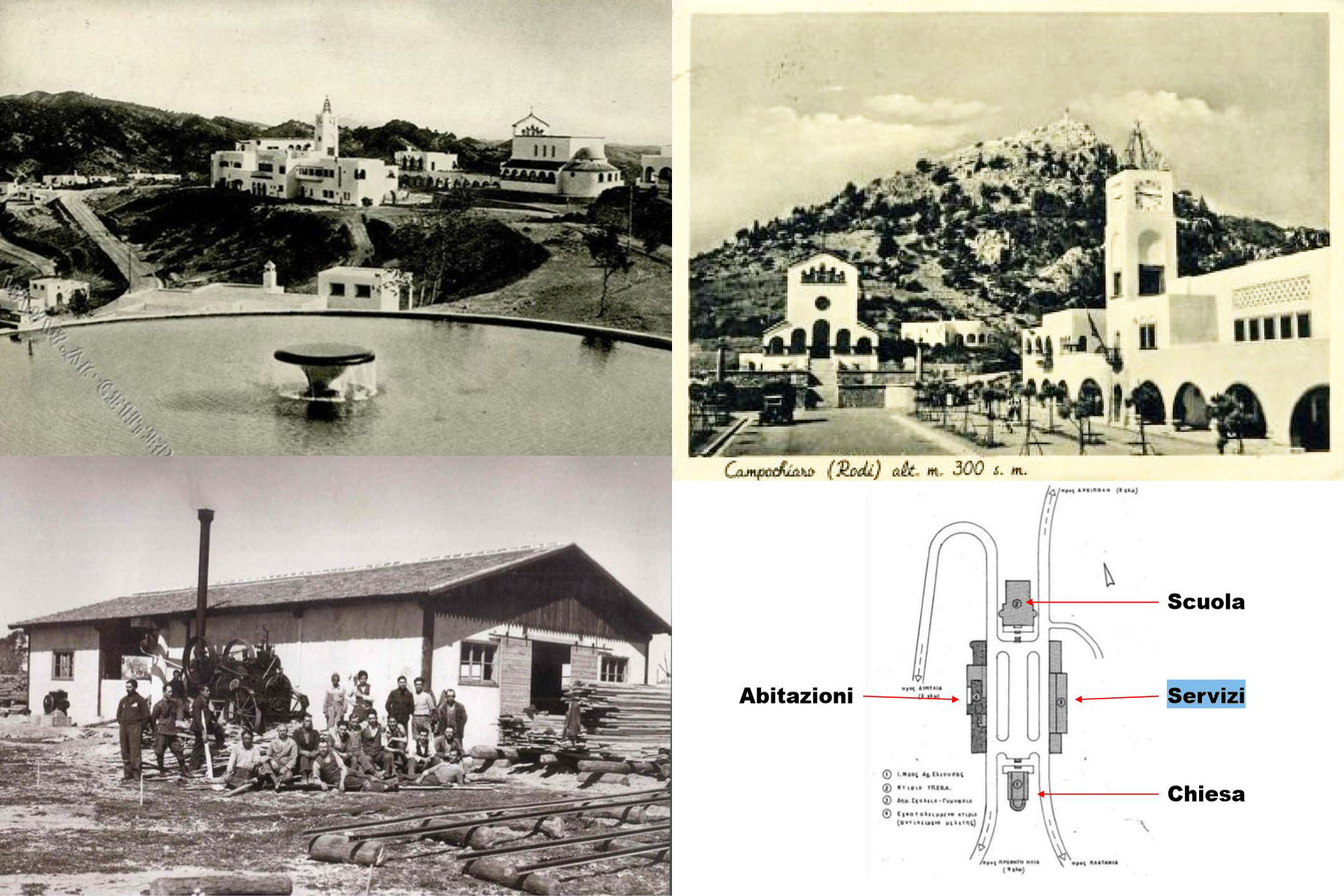
A collection of historic photos of the old Campochiaro
Campochiaro was built in a very strategic location in the mountains of Rhodes. New roads connected the rural settlements to the capital and helped transport timber, goods, and, later, even military equipment across the island. During this period, the main roads leading from Rhodes Town towards Profitis Ilias and Lindos were paved with asphalt — a major development for the time.
The village also stood along the route to the elegant mountain hotels Elafos Hotel and Elafina, built high in the forests of Profitis Ilias, as well as the nearby villa where governors and Italian officials escaped during the hot summer months. Among them were Governor Mario Lago and, later, Cesare Maria De Vecchi. The surrounding forests were carefully maintained and cleaned, not only for forestry work but also for hunting and recreation.
This may explain why Campochiaro was built with such impressive public buildings for a small mountain village — including a Catholic church, school, market, and administrative buildings. The settlement was designed to impress visitors and create a familiar atmosphere for the Italian families living there.
But like many ambitious projects of that era, the village was also part of the wider political propaganda of the fascist regime. And, like the regime itself, that chapter of history did not last long.

A monument for Italian soldiers
In 1936, a new governor arrived on Rhodes — Cesare Maria De Vecchi, one of Benito Mussolini’s closest associates. Under his rule, strict regulations were introduced and the island became heavily militarized. Several villages across Rhodes were adapted for military purposes, and during World War II, Campochiaro grew into an important military base housing thousands of Italian soldiers.
Many of the village’s public buildings were converted to serve the army’s needs, while one of them even functioned as a military prison. During these difficult years, Italian forces on the island faced resistance from local Greek groups seeking freedom, attacks from Allied forces trying to capture the Dodecanese islands, and eventually the advance of the German army.
On September 11, 1943, the Italian forces on Rhodes surrendered to the Germans during the Battle of Rhodes — one of the last major German victories of the war. Soon after, the Italian forestry workers and their families, no longer supported by the Italian government, were forced to leave the island. The final Italian family departed in 1947, when the Dodecanese islands officially became part of Greece once again.
The story of these families from the Trentino region and their life in Campochiaro was later carefully documented by journalist, sociologist, and historian Renzo Maria Grosselli in his extensive research published in 2013.: “Gli uomini del legno sull’isola delle rose: La vicenda storica del villaggio italiano di Campochiaro a Rodi 1935-1947”.
Eleousa Sanatorium
After the Dodecanese islands officially united with Greece, Campochiaro was renamed Eleousa, taking its name from “Aghia Eleousa,” meaning “Our Lady of Tenderness.” The village church, originally built as a Catholic church during the Italian period, was later converted into a Greek Orthodox church and dedicated to Saint Charalambos.

Eleousa Church St Charalambos
The abandoned buildings proved to be a perfect place to house patients with tuberculosis. The Sanatorium of Saint Eleousa represents an important part of the history of respiratory medicine in the Dodecanese.

The old Italian school and later – hospital
The Sanatorium named “Queen Frederica” initially had a capacity of 80 patients and 54 staff members. The central personality in the history of the sanatorium was the respiratory physician Emmanuel G. Kostaridis, who was the scientific director of the institute and the administrative director for more than 15 years.

Eleousa Sanatorium with Dr. Kostaridis
The sanatorium in Eleousa was among the first therapeutic institutions in Greece to introduce isoniazid, the “new” tuberculosis drug of its time. Over its 23-year operation, the sanatorium treated a total of 1,581 patients from different parts of the country.
Eventually, however, a combination of factors led to its closure in August 1970 — its remote mountain location far from the town, limited laboratory and medical support, bureaucratic difficulties, and finally the retirement of its director.
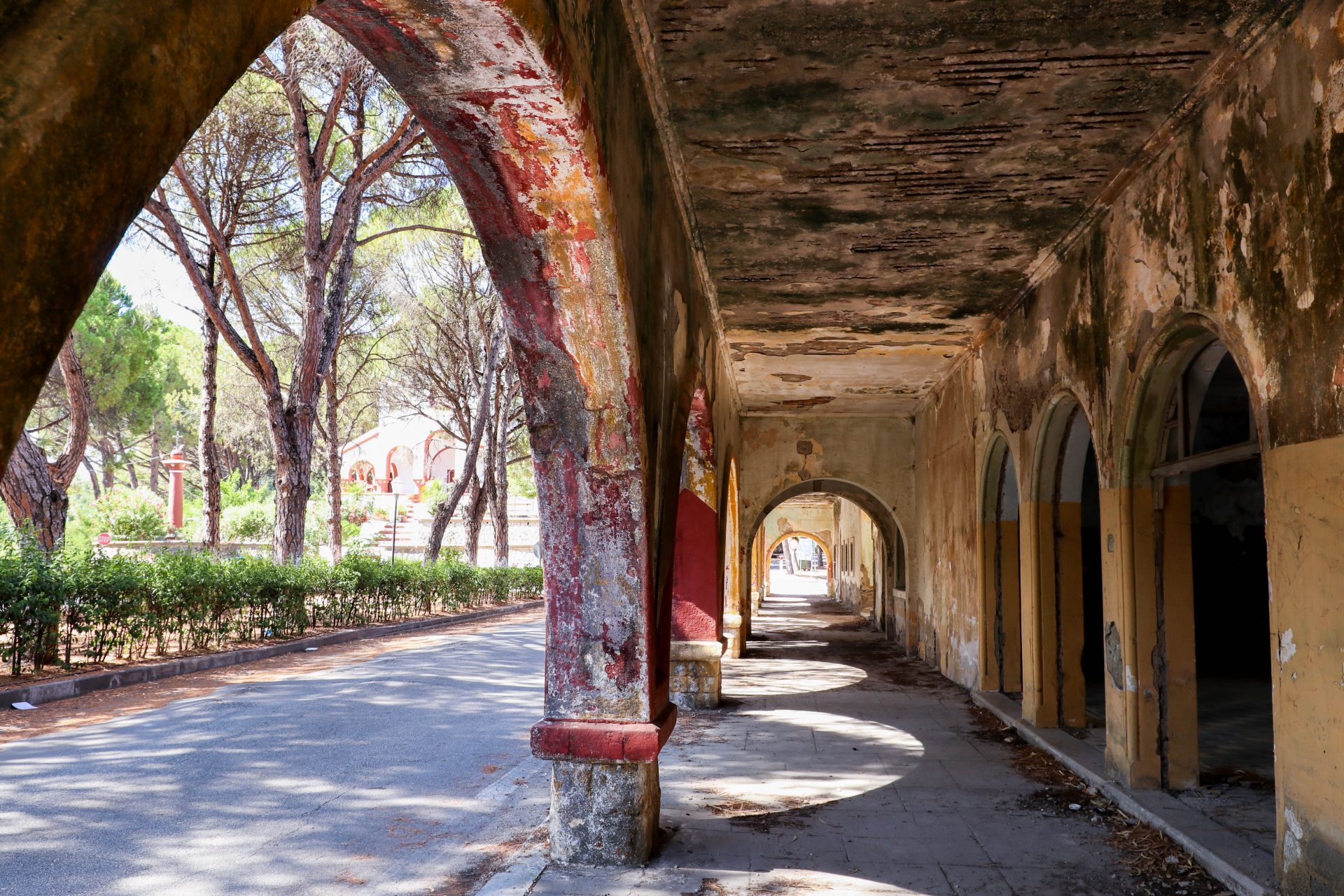
The never-disappearing charm of the abandoned building
Since then, nothing has been done to utilize or preserve the impressive premises, and we can only hope that one day the ghost city will become a beautiful green space for all of us to treasure.
Sources: Rodiaki.
Eleousa Fountain and “Gizani”
Further down the road, following signs for Profitis Ilias, you come across an enormous Italian-built reservoir with a fountain – a beautiful & refreshing oasis in the middle of the mountains. The cistern was built as part of an irrigation system to supply the village and its fields with fresh water from the Koskinisti spring. Because of the many plane trees surrounding the fountain, the water appears emerald green!

Eleousa Fountain & Gizani fish
Amongst gold fish, you will also notice a small fish Gizani («Ladigesocypris ghigii-Pisces Cyprinidae») – the only freshwater fish that is endemic to Rhodes and lives in the springs and the streams of Rhodes. Although Gizani is referred to “Lilliputian champion of survival”, it is listed in Annex II of the European Union Directive for Habitats Protection (92/43/EEC) as an endangered species of top priority, as well as in the Red Book of Endangered Species of Greece. It is also protected by Presidential Decree No 67/1981 of the Greek State.
To learn more about Italian woodworkers and how Greeks were helping and hiding them from Germans so they could survive, go to one of the local taverns and speak with their owners. They will have many stories from their families to tell. We recommend – Oasis.
If you have been to Eleousa, let us know what you thought! If you find this information useful and interesting, make sure to share it with us on social media! We will be very happy and appreciate it!


